Best Courier Dispatch Software for Small Courier Companies in 2026
Eight courier dispatch tools compared on price for 3, 5 and 10 drivers, free plans, and routes vs on-demand jobs.

Comparisons
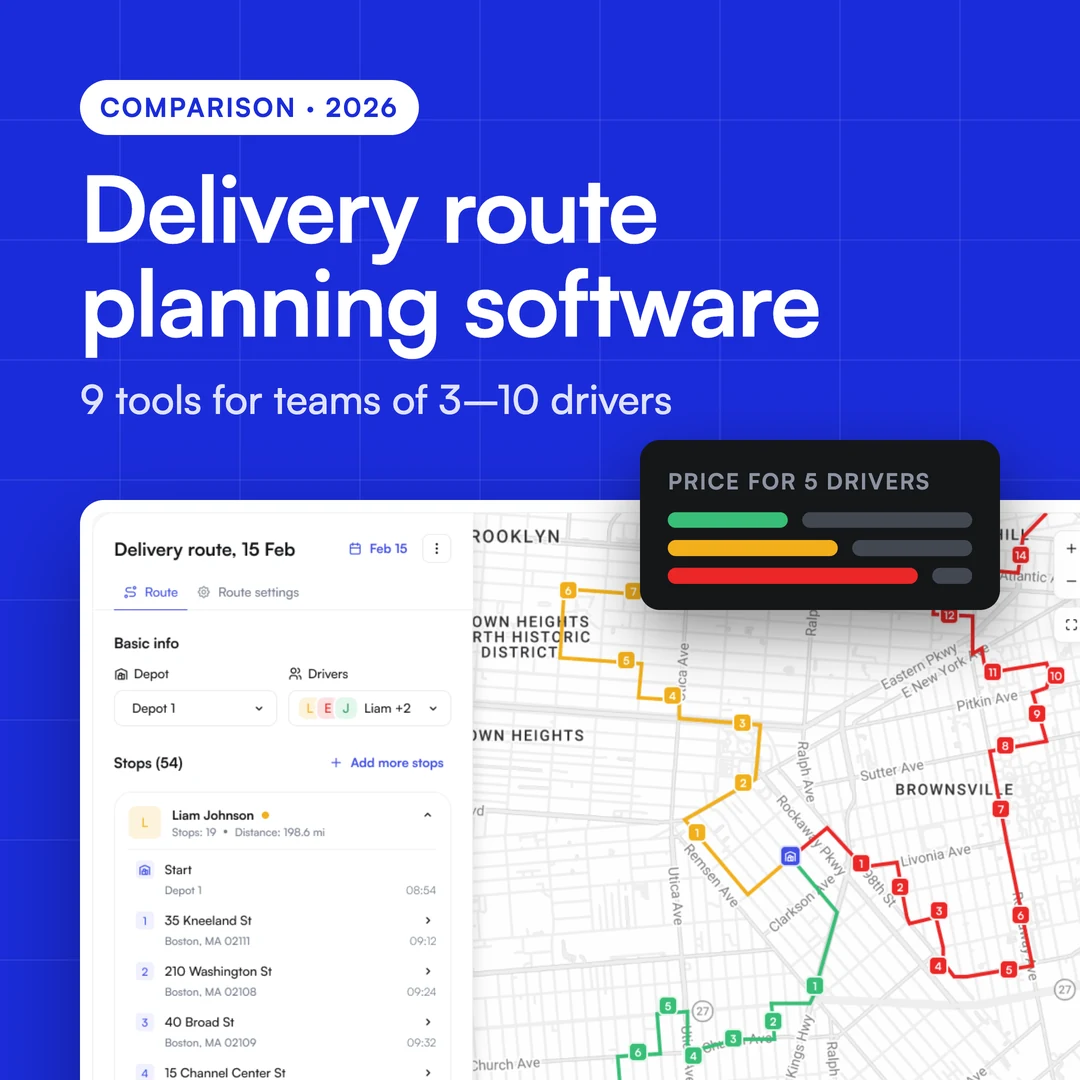
If someone on your team still splits tomorrow's stops by hand and texts each driver a manifest, you have outgrown route planner apps. The best delivery route planning software for that job is built for a dispatcher and a handful of drivers. The nine tools below are the ones a business with 3 to 10 drivers ends up choosing between. For each: what it costs for 3, 5 and 10 drivers, what the free plan covers, and where it lets you down.
Prices are US pricing from each vendor's own page, checked on 4 November 2026. Last verified 5 November 2026.
| Tool | Who it suits | Free plan or trial | 5 drivers, 1,000 stops a month | Proof of delivery |
|---|---|---|---|---|
| Optiway Dispatch | most small teams: free to start, smart import, flexible routes | 300 stops a month, no card, no expiry | $99 | in the plan |
| OptimoRoute | mixed delivery and service work | 30-day trial, no card | $245 (Pro) | Pro tier |
| Spoke Dispatch | quick setup, strong driver app | 7-day trial | $125 | in the plan |
| Routific | balanced routes and reports | 100 orders a month, no expiry | $150 | in the plan |
| Upper Crew | teams that already plan in Upper | 7-day trial, no card | $250 (+$100 for customer tracking) | in the plan |
| Zeo Fleet | API and webhooks from day one | 7-day trial, no card | $250, billed yearly | in the plan |
| Onfleet | 10+ drivers with a developer on staff | trial or demo on request | $619 (Launch) | in the plan |
| Route4Me | brand age and integrations, price on request | 7-day trial, no card | $199 for a package with a set number of users (how many isn't published); drivers count as users, extra users cost more | in the driver app |
| Track-POD | proof of delivery first | 7-day trial, no card | $295 ($245 billed yearly; 3-driver minimum) | the most detailed |
For a delivery business with 3 to 10 drivers, the best delivery route planning software charges for stops, not for drivers. Optiway Dispatch ($99 a month for 2,000 stops), Spoke Dispatch ($125 for 1,000 stops) and Routific ($150 for 1,000 orders) let you add every driver for free. Per-driver tools such as OptimoRoute ($49 per driver a month), Upper Crew ($50 per user) and Zeo Fleet ($599 per driver a year) look cheap with two drivers and stop looking cheap around the fourth. Onfleet starts at $619 a month and is built for teams well past ten.
Our pick for most teams in that range is Optiway Dispatch. It is ours, so we will say why plainly. The free plan never expires and needs no card. The whole flow fits in a paragraph: you add your drivers' emails in the Drivers tab, and each driver accepts the invitation in the Optiway Route Planner app on iOS or Android. You upload tomorrow's stops as a spreadsheet; the import reads it even with typos in it. The board splits the stops between drivers and sends each one their route straight to the Optiway Route Planner app on their phone. During the day you watch every driver on the map, and if someone drops out, you hand their route to another driver in a click. Pricing: free up to 300 stops a month on Early Access, $99 for 2,000 on Team, $199 for 5,000 on Business.
Each of the others wins somewhere. Routific on balanced routes and reports. OptimoRoute on its API and a 30-day trial. Spoke on quick setup and a strong driver app. Zeo on an API from day one. Onfleet on enterprise-grade tracking. Route4Me on brand age and integrations. Track-POD on proof of delivery.
Vendors use three names for what are really two products. Route planning software and route optimization software are the same thing in practice: an app that takes your list of addresses and puts them in the fastest order. One driver, one phone, $10 to $20 a month. Dispatch and routing software is different, and you will also see it called route management software, route scheduling software or delivery management software. It is a web platform for the person who runs the day: they upload all the stops, split them between drivers, see where every van is and get proof of delivery back. The company pays for it, from $99 a month. Every tool in this article is this second kind, delivery dispatch software in plain terms.
The first kind, multi stop route planning software for one phone, is probably on your drivers' phones already: Spoke, Optiway, Zeo, MyWay or Route4Me. One phone, one route, done. We compared eight of them in best apps for delivery drivers and couriers. With one driver, that is the article you want.
You need the second kind the morning someone has to collect everyone's addresses, split them by hand and send each driver a manifest. From then on the questions change. Who takes the stops that came in after 9 a.m.? Where is van two right now? Did stop 14 get a photo? A route optimizer answers none of them. Dispatch does; dispatching vs routing draws the line in detail.
So what does that platform actually do once you have it? Whatever the vendor calls it, every tool in this comparison does the same four jobs:
What differs, and what matters at your size, is how you pay (per stop or per driver), how big the free plan or trial is, and how convenient the driver app is for your drivers.
What delivery routing software costs for five drivers and 1,000 deliveries a month, cheapest first: Optiway Dispatch $99, Spoke Dispatch $125, Routific $150, OptimoRoute $245, Upper Crew $250, Zeo Fleet $250 billed yearly, Track-POD $295, Onfleet $619. Route4Me lists $199 a month for a package that includes a set number of users, with drivers counted as users and extra users billed on top; how many users $199 covers is not published. The crossover is the fourth driver. With three drivers a per-seat plan costs about the same as a per-stop plan; from four or five, every driver you add costs $49 to $60 a month on a per-seat plan and nothing on a per-stop plan.
Here is what route planning software for small business costs by team size. Stops move the price more than drivers do, so each column fixes both. Monthly billing where it exists; Zeo bills yearly and is shown as a monthly equivalent. US pricing, checked 4 November 2026.
| Tool | How you pay | 3 drivers, 1,000 stops | 5 drivers, 2,000 stops | 10 drivers, 5,000 stops |
|---|---|---|---|---|
| Optiway Dispatch | per stop, drivers free | $99 | $99 | $199 (Business) |
| OptimoRoute | per driver (Pro, monthly) | $147 | $245 | $490 |
| Spoke Dispatch | per stop, drivers free | $125 | $165 (Starter + 1,000 extra stops at $0.04) | $285 (Starter + 4,000 extra stops at $0.04) |
| Routific | per order, drivers free | $150 | $300 ($150 + 1,000 orders at $0.15) | $630 |
| Upper Crew | per user (Starter, monthly) | $150 | $250 | $500 |
| Zeo Fleet | per driver, billed yearly | $150 ($1,797 a year) | $250 ($2,995 a year) | $499 ($5,990 a year) |
| Route4Me | package with a set number of users, extra users billed on top (count not published) | $199 plus extra users | $199 plus extra users | from $199 plus extra users; get a quote |
| Track-POD | per driver (Advanced, monthly), 3-driver minimum | $177 | $295 | $590 |
| Onfleet | per plan, tasks included | $619 (Launch, 2,500 tasks) | $619 | $1,349 (Scale, 5,000 tasks) |
Per-stop plans grow with volume too. At Routific every order above 1,000 is billed on top of the $150, $0.15 each at first and down to $0.03 past 20,000 orders; Spoke charges $0.04 to $0.07 for every stop over the allowance; above 2,000 stops Optiway moves you to Business, $199 for 5,000, and to a custom plan above 5,000. Per-driver plans often cost more than the seat: Upper's live tracking for customers is $20 per driver on top, OptimoRoute's proof of delivery needs the Pro tier, and Zeo bills only quarterly or yearly, so $499 a month for 10 drivers is $5,990 up front.
Yes. Two of the nine offer free route planning software for a team, not just a trial. Optiway Dispatch is free up to 300 stops a month with every feature and unlimited drivers; Routific is free up to 100 orders a month with every feature except SMS. Neither expires, Optiway needs no card, and both allowances are monthly: Optiway's 300 stops reset on the 1st of each month, and Routific's 100 orders are listed per month as well. The rest are trials: 30 days at OptimoRoute (no card), 7 days at Upper (up to 5 users), Zeo, Route4Me, Track-POD and Spoke Dispatch, and a trial or demo on request at Onfleet.
Free driver apps are a different thing. Driver apps such as Spoke, MyWay, Zeo and Straightaway have small free tiers, but each is one phone planning one route. None of them splits a list between three drivers or shows you where the vans are. Free dispatch for a team means Optiway's 300 stops or Routific's 100 orders.
How far does a free plan go? 300 stops is a busy day or a quiet week for a small team, with no limit on drivers; 100 orders is a quiet week. Both are enough for the only test that matters: take yesterday's real stop list, upload it, split it, send the routes to two drivers' phones and see whether the proof of delivery comes back the way your customers expect. Free dispatch software: what you actually get goes through the free plans line by line.
Optiway Dispatch is free for 300 stops a month on the Early Access plan, with unlimited drivers and dispatchers and every feature included, $99 a month for 2,000 stops on the Team plan, and $199 for 5,000 on Business. Above 5,000 stops you get a custom plan. No card to start. Drivers run their routes in the Optiway Route Planner app on iOS and Android.
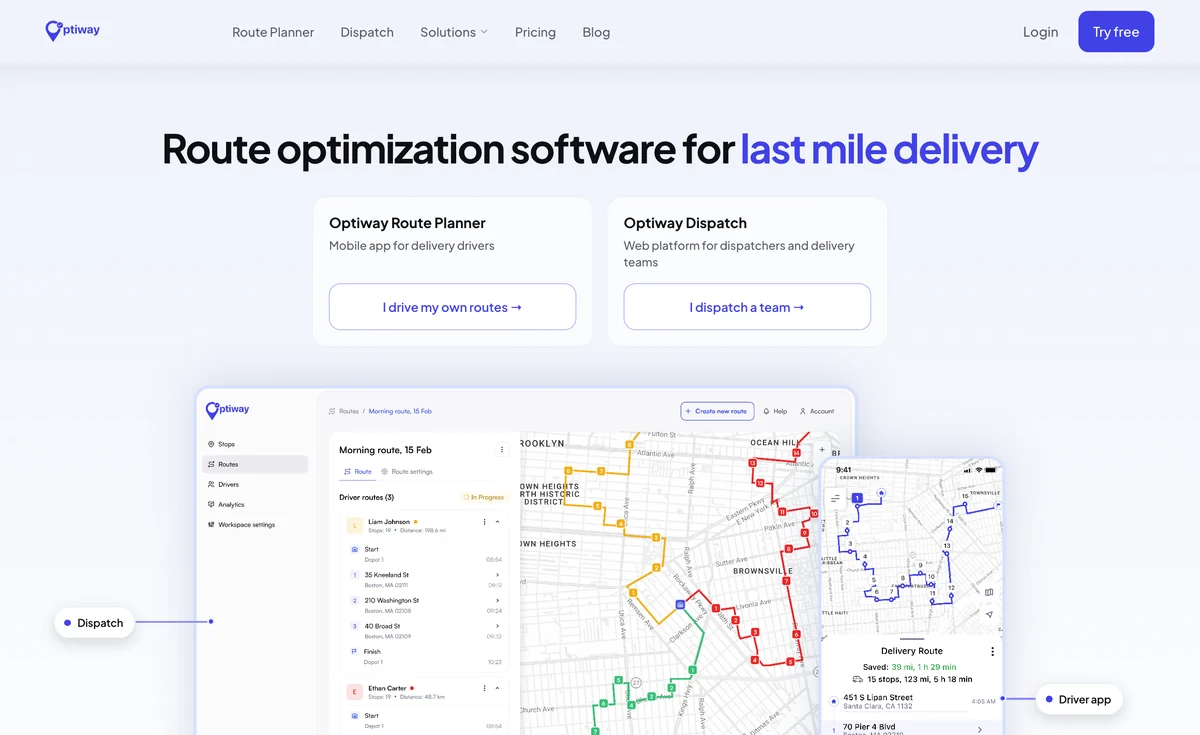
Yes, this one is ours. What follows is what we are good at, what the others do better, and a free plan to check every word on your own stop list.
Where Optiway wins. Starting costs nothing and takes minutes: the free plan never expires, needs no card and includes every feature. Setup is adding your drivers' emails in the Drivers tab; each driver accepts the invitation in the Optiway Route Planner app on their phone, and from that moment every route you build and send in Optiway Dispatch lands in the Optiway Route Planner app on their phone automatically. Getting stops in is the part people expect to hurt, and it doesn't. Upload tomorrow's list as xlsx, xls, csv or txt and the import reads it even when the columns are a mess and the addresses have typos, flagging only what it couldn't place. During the day, routes stay flexible. When someone calls in sick at 8 a.m., you hand their whole route to another driver in a click, and you can reorder stops by hand at any time. Meanwhile you watch every driver on the map in real time, each stop flips to done or failed, and proof of delivery (photo, signature or note) lands in Optiway Dispatch.
Free: 300 stops a month on Early Access, with as many drivers and dispatchers as you like. The allowance resets on the 1st of every month, and the plan doesn't expire.
Integrations: orders come in automatically through the Zapier integration, which connects Shopify, WooCommerce and thousands of other apps, and through the public API.
Where it falls short: customers don't get an ETA text or a tracking link yet (customer notifications are coming soon); if yours expect one today, look at Spoke or Onfleet, where texts are billed per message, or Routific's SMS add-on. What Optiway Dispatch does and how drivers receive and run their routes show the board and the phone side.
OptimoRoute charges per driver. Lite is $35.10 per driver a month on annual billing, Pro is $44.10 annually or $49 month to month, and the 30-day trial needs no credit card. Five drivers on Pro are $245 a month by OptimoRoute's own example; ten are $490.
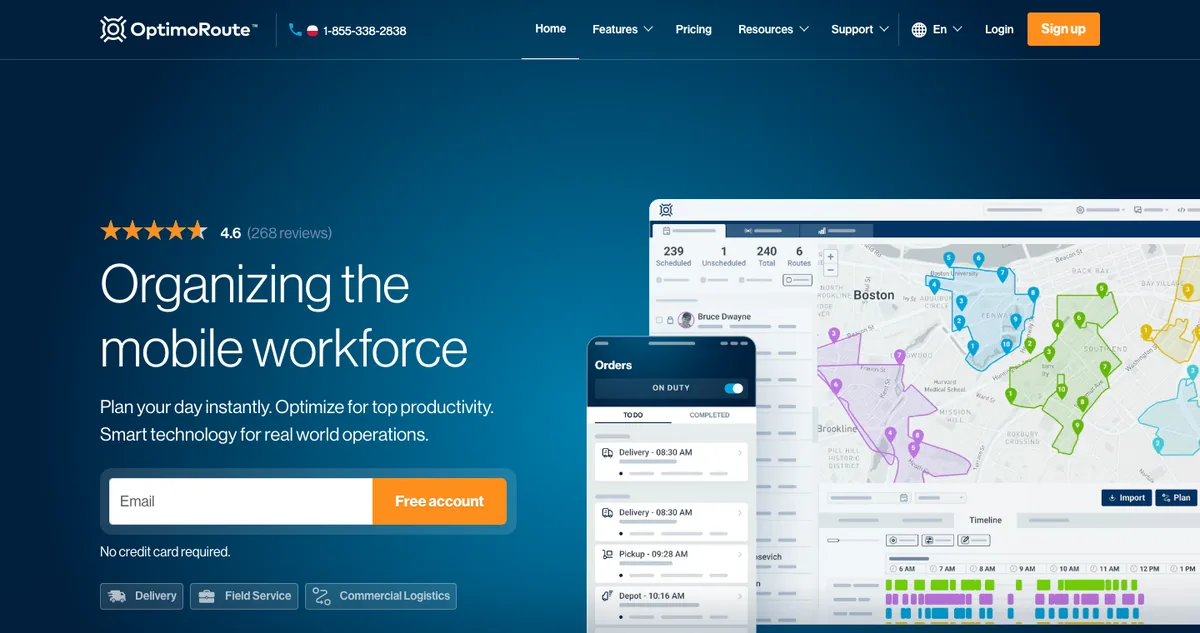
Best for: a business that mixes deliveries with service calls (installs, repairs, pickups) and wants one planner for both, with weekly planning on Pro when you ask for it. OptimoRoute also has a public API on every plan.
Free: a 30-day trial with Pro features, no card, capped at 250 orders. It is the longest trial in this comparison.
Where it falls short: proof of delivery, analytics and real-time order tracking are Pro features, so the plan a delivery business actually needs is the $49 one. Per-driver billing takes it to $490 a month at 10 drivers, and it is built for fleets and field service, so a three-van bakery pays for depth it will never open. Lite caps planning at 700 orders at once, Pro at 1,000, and multi-day routes need a Custom plan.
Spoke Dispatch costs $125 a month for 1,000 stops on Starter, with unlimited drivers and $0.04 for each stop over the allowance. Premium is $200 for 2,000 stops ($0.06 extra), Expert $1,000 for 12,000. One detail worth knowing: Starter's extra stops are cheaper than Premium's, so a 5,000-stop month costs $285 on Starter and $380 on Premium.
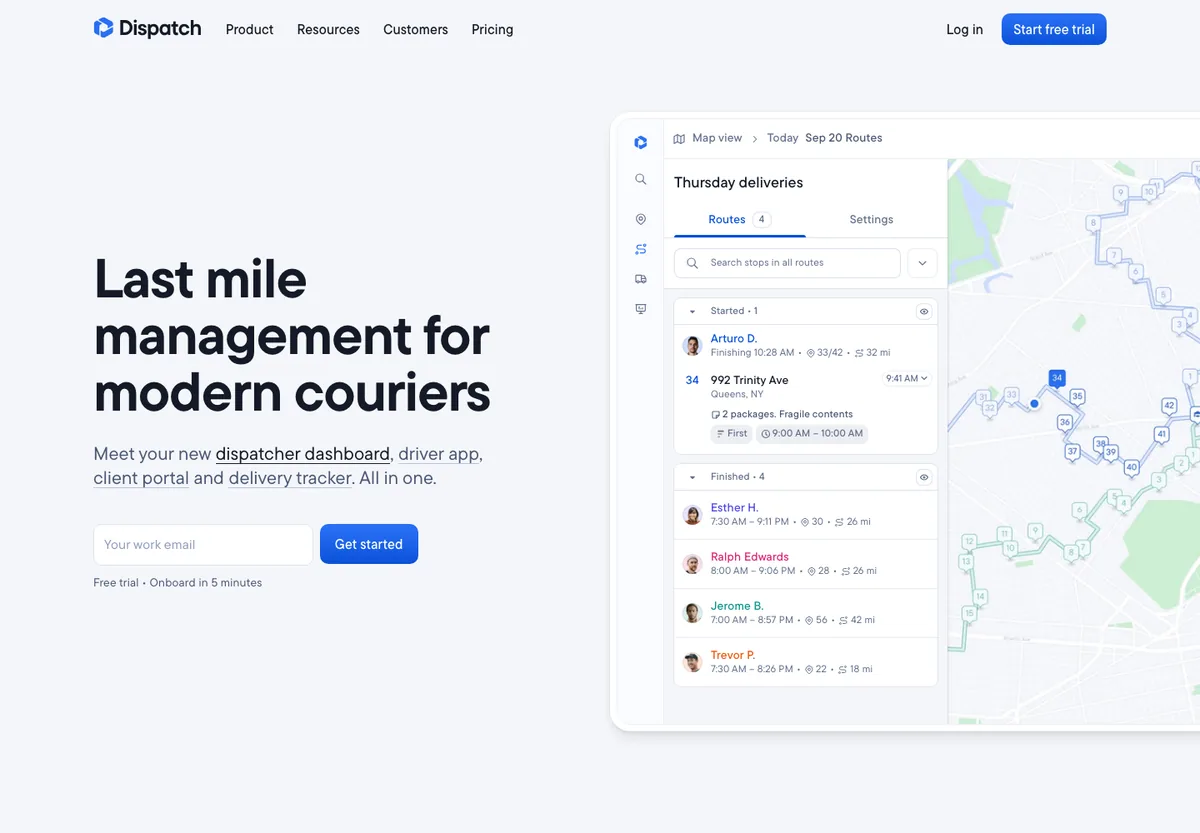
Best for: a small courier or parcel operation where one person plans and the drivers work fairly independently. The dashboard is quick to learn and the driver app is a strong one: it navigates inside the app, and Package Finder lets drivers tag where each parcel sits in the van while loading, so the search at the door disappears. Reports on failed deliveries, on-time rates and cost per delivery are built in, proof of delivery is in the plan, and the API, Shopify and Zapier connections come with every plan. Email notifications to customers are free; SMS is charged per message.
Free: no free plan. A 7-day trial of the full product.
Where it falls short: there is no free plan, so the only way to test it on your own stops is the 7-day trial. Starter also keeps your data for only 30 days; a year of history needs Premium.
Routific costs $150 a month for up to 1,000 orders with as many drivers as you like, and it is free up to 100 orders a month with every feature except SMS. Above 1,000 orders you pay per order on a sliding scale, $0.15 an order for orders 1,001 to 2,000 down to $0.03 past 20,000, so a 10-driver team doing 5,000 stops pays about $630.
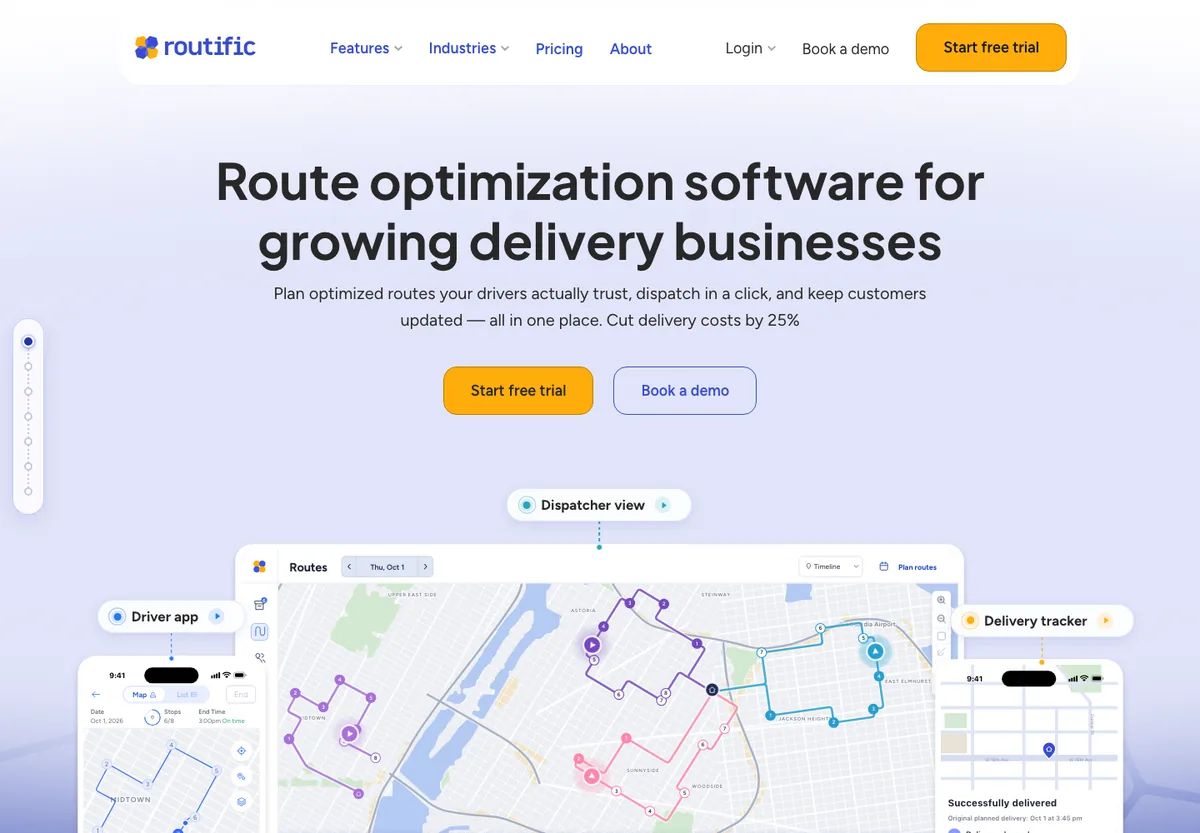
Best for: a team that wants the dispatcher's side done well from the first day. Routific's planner balances work between drivers, respects time windows and shifts, and its reports cover stops per driver, on-time rate and distance.
Free: 100 orders a month. Enough for a two-van business to run a quiet week, not a busy one.
Where it falls short: the free plan ends at 100 orders and the next step is straight to $150, so a team doing 300 orders a month pays the same as one doing 1,000. Customer SMS is a quoted add-on priced by country, and the route optimization API is priced separately. The driver app does the job; it is not one drivers pick for themselves.
Upper's team plans cost $50 per user a month on Starter (250 stops per route, 10 driver profiles), $60 on Professional (500 stops, 15 drivers) and $89 on Optimize (1,500 stops, 30 drivers), with 20% off for yearly billing. The 7-day trial needs no card, gives you Professional features and up to 5 users.
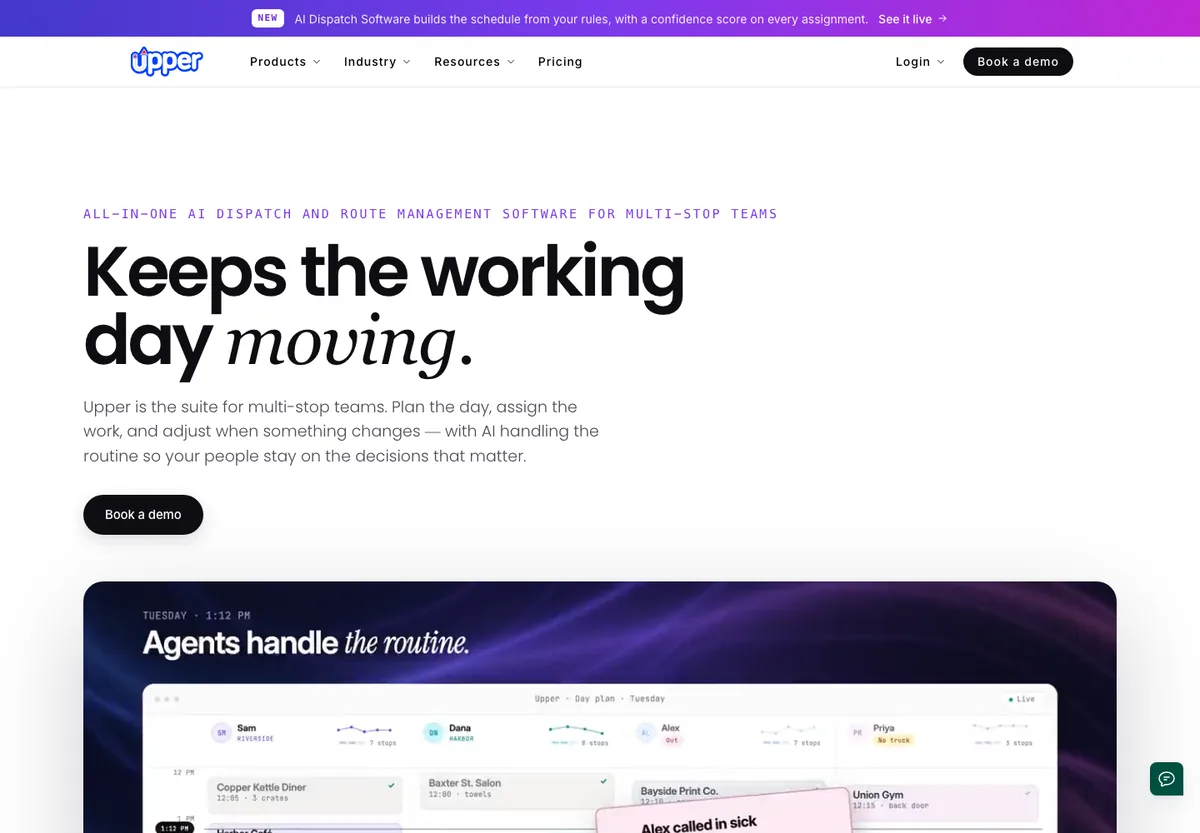
Best for: a business that already routes in the Upper driver app (the Solo product) and wants the dispatcher's board from the same vendor, with unlimited routes a month and a phone side the drivers know. The planner is quick to learn, and the per-route stop limits are generous for local delivery.
Free: 7-day trial only, no card.
Where it falls short: everything a delivery customer notices is an add-on. Live tracking for customers is $20 per driver a month, capacity optimization $25 per driver, barcode scanning $50 per company on Starter, customer texts from $0.01 a message. A 5-driver team that wants customers to see the van on a map pays $250 for seats plus $100 for tracking, $350 against $99 to $300 for the per-stop tools. Starter also caps you at 10 driver profiles; the eleventh driver means the Professional plan.
Zeo Fleet Management costs $599 per driver a year, billed yearly or quarterly (yearly is 20% cheaper), with no monthly option. That is about $50 per driver a month, or $2,995 a year up front for five drivers. The 7-day trial on every plan needs no card.
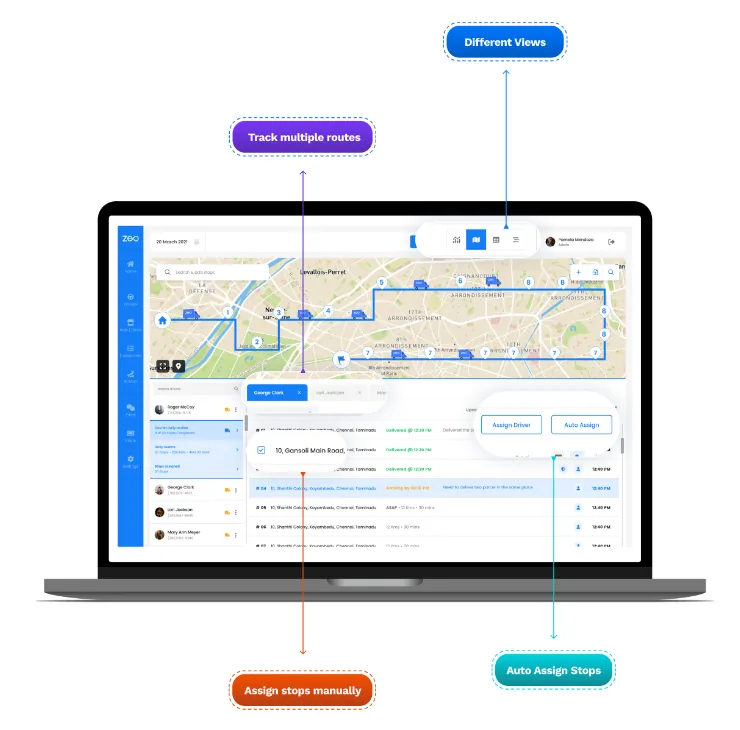
Best for: a small team with a technical person who wants orders connected automatically from day one. The Fleet tier includes an API and webhooks, automated triggers, store zones, recurring routes and a real-time operations dashboard, which the per-stop tools either charge extra for or don't have.
Free: 7-day trial, no card.
Where it falls short: you pay a year or a quarter in advance per driver, so a seasonal team pays for its December headcount in July. The pricing page lists only the yearly figure and doesn't state stop limits for Fleet, so ask before you sign. A two-van business that doesn't need an API is better off on the Route Management tier or a per-stop tool.
Onfleet starts at $619 a month on the Launch plan with 2,500 tasks included, $1,349 on Scale with 5,000 tasks, and about $3,099 on Enterprise. Extra deliveries are billed per task, users are unlimited, and a trial or demo is available on request. A Courier Suite add-on starts at $299 a month on top of any plan.
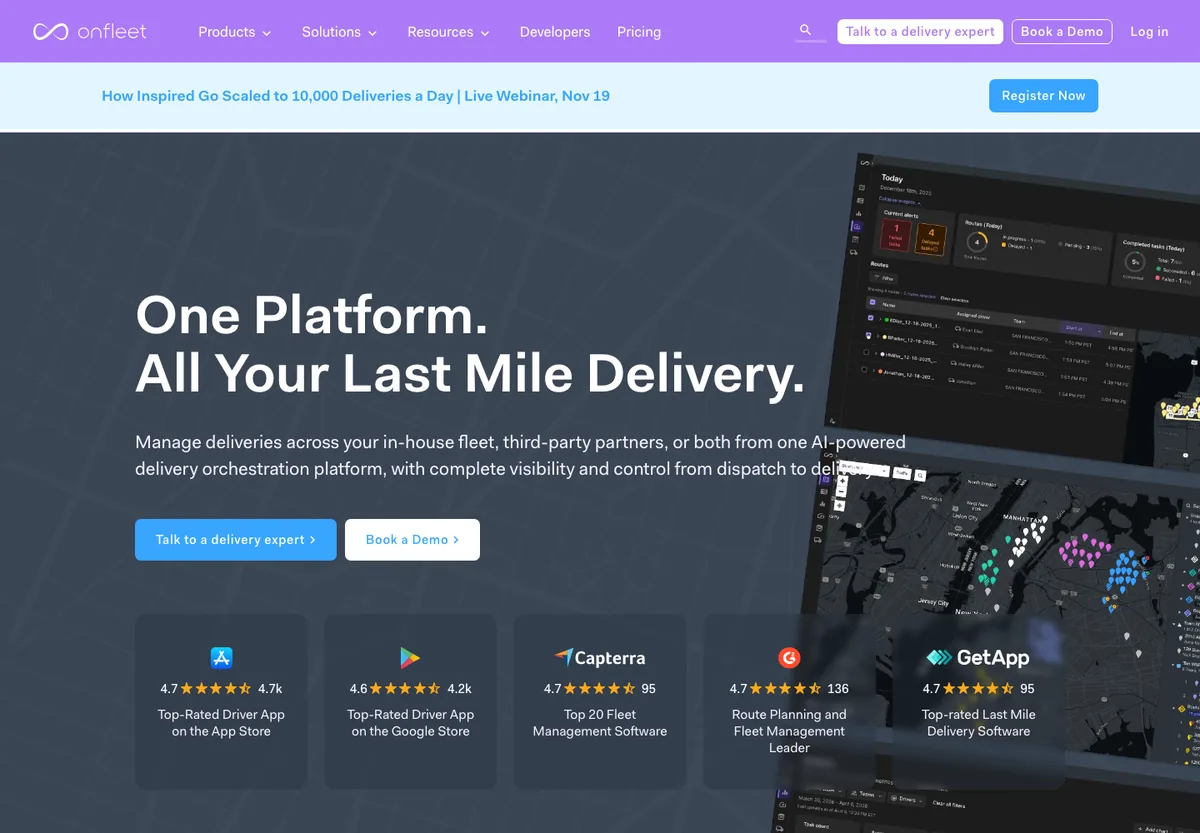
Best for: one of the longest-standing tools here, around since 2012, for a delivery business that has grown past the spreadsheet stage, has someone to use the API, and sells to customers who expect Amazon-style tracking links, predictive ETAs and branded notifications. Industry roundups put it near the top for larger last-mile operations.
Free: no free plan; a trial or demo on request.
Where it falls short: price. For three drivers doing 1,000 stops, Onfleet costs six times Optiway Dispatch and four times Routific, and the 2,500 tasks you pay for sit unused. The Courier Suite is an add-on, not a smaller plan, so there is no cheap way in for a parcel courier. Launch also comes with basic route optimization and 90 days of reports; the advanced version starts on Scale, and SMS is billed by usage. Under 10 drivers, Onfleet is where you may end up, not where you start; we price seven cheaper options in Onfleet alternatives.
Route4Me lists plans from $199 a month, with a 7-day trial and no card. What the page doesn't say is how many users each plan includes. Route4Me's billing page explains the model: a plan covers a set number of users, drivers count as users, and every extra user costs more. So $199 is the starting point, not the bill for a five-driver team. Ask for a quote before you budget.
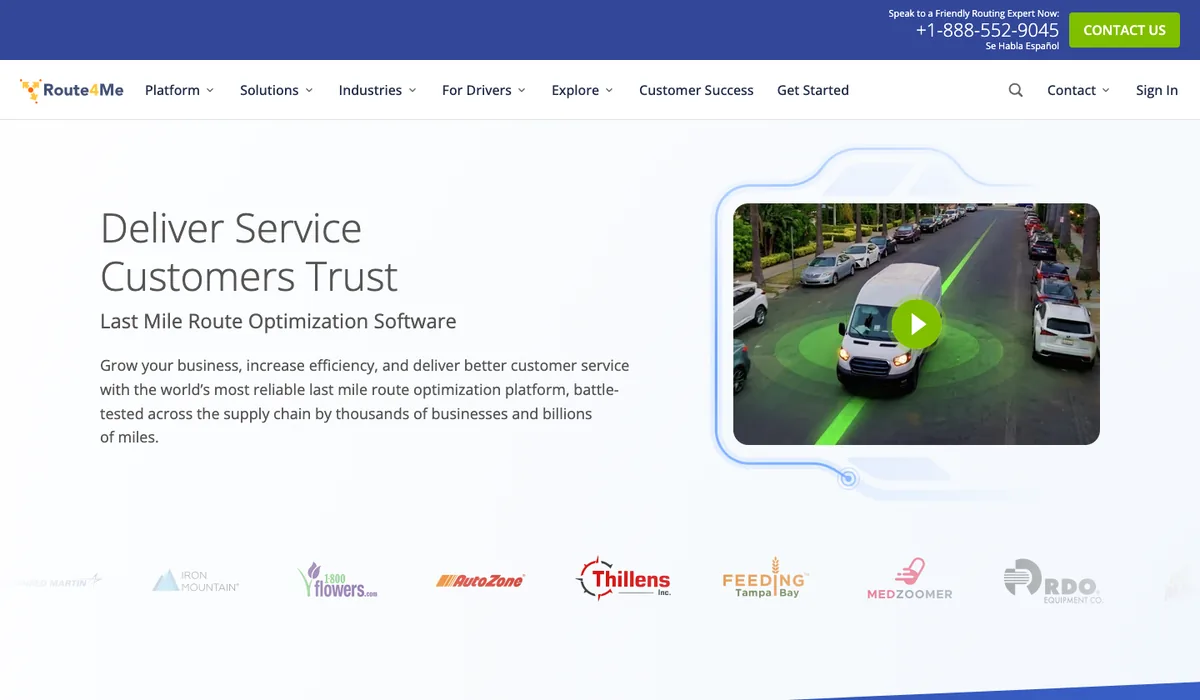
Best for: a team that wants the longest track record of these nine. Route4Me has been routing since 2009. It covers the full list: optimization with time windows, a driver app with voice navigation and proof of delivery with video, live tracking, customer notifications (texts are a paid add-on) and an API with a broad set of integrations.
Free: 7-day trial of the platform, no card.
Where it falls short: you can't price it without a sales call: the page shows no user counts, stop limits or annual discount. Every driver is a billed user, so the bill grows with the team. And the platform is built for operations far bigger than three vans.
Track-POD charges per driver with a three-driver minimum. Advanced is $49 per driver a month billed yearly or $59 month to month (6,000 orders a month), Advanced Plus $69 or $79 with unlimited orders, Ultimate $89 or $99. Five drivers on Advanced are $295 a month, or $245 on yearly billing. Per-order plans with unlimited drivers start at $510 for 3,000 orders. The free trial needs no card.
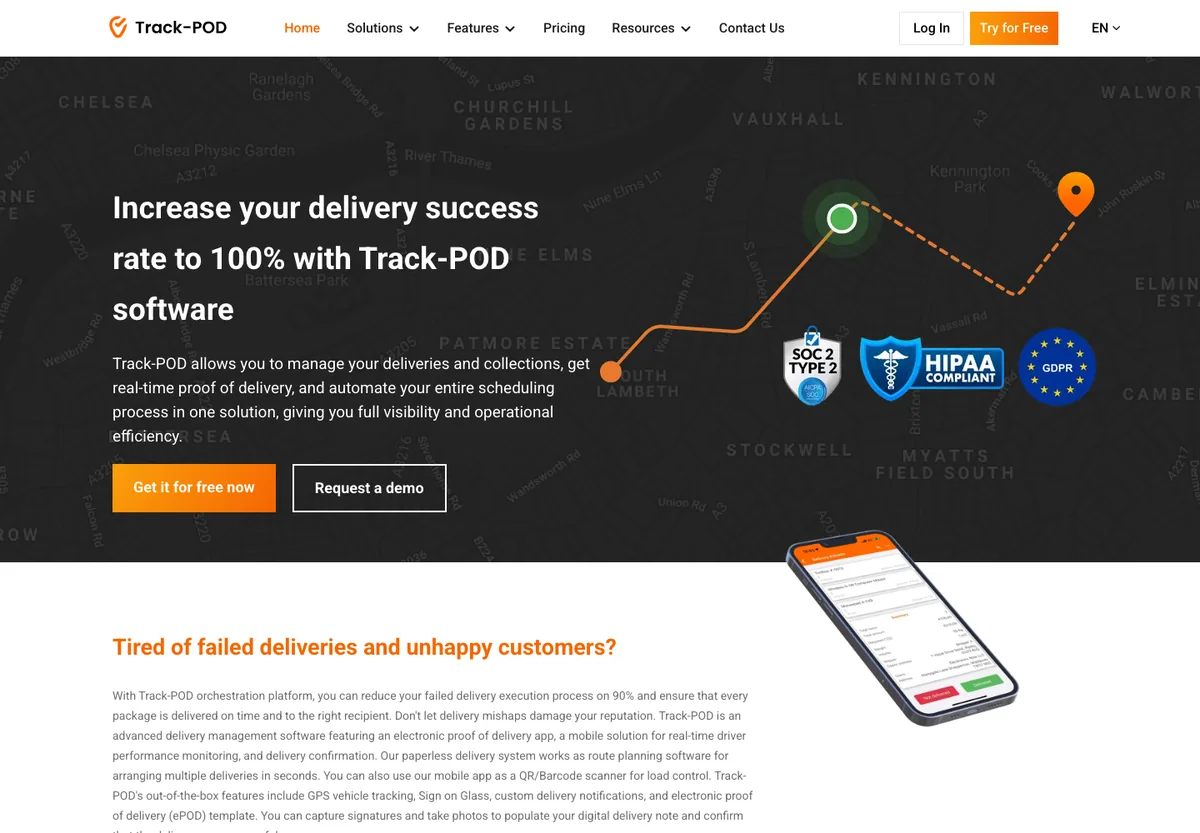
Best for: a delivery business whose contracts depend on proof of delivery: pharmacies, wholesale, furniture, anything signed for. Track-POD's proof of delivery is more detailed than the rest: signature, up to 10 or 20 photos per order, barcode and QR scanning, PIN confirmation, geotags and timestamps, and a REST API on every plan. Live tracking for customers with ETA updates is in the plan too.
Free: a 7-day trial, no card. No free plan.
Where it falls short: the three-driver minimum means a two-van business pays for three seats, and per-driver billing puts it at $590 a month for ten drivers month to month, well above the per-stop tools. SMS to customers is billed separately in every country, and the cheapest plan caps you at 6,000 orders a month.
Courier work is different for the dispatcher. A courier often does 100 stops a day or more, the day starts with a depot manifest of several hundred parcels rather than a tidy order list, and every parcel needs proof of delivery. Courier route planning software (people also search for it as courier routing software or courier route optimization software) has to split that manifest across drivers, keep the proof of delivery in the plan and stay affordable at that volume. On the dispatcher side, that comes down to two questions: how the manifest gets in, and what the volume costs.
Getting the manifest in. Every platform here imports a spreadsheet. Optiway reads xlsx, xls, csv or txt even when the columns are messy and flags only the addresses it couldn't place. Routific and OptimoRoute import spreadsheets cleanly, and OptimoRoute's weekly planning suits fixed delivery days. Track-POD and Route4Me add barcode scanning to proof of delivery in the plan, Spoke includes it on every plan and Routific as part of proof of delivery, Upper includes barcode scanning from Professional or charges $50 a month on Starter, and Onfleet sells a Courier Suite from $299 a month on top of any plan. What the driver can do with the parcels in the van, scanning labels and finding the right bag, is a driver-app question, and we compare that in the driver-app article linked below.
Volume is the other difference, and it changes the maths. Five couriers at 100 stops a day make 10,000 to 12,000 stops a month. At that level per-stop pricing stops being cheap: Spoke comes to about $565 on Starter with extra stops, Routific to about $1,000, and Optiway moves you to a custom plan. Per-driver pricing holds: five seats on OptimoRoute stay at $245 with no monthly cap (Pro plans up to 1,000 orders at a time), and Track-POD at that volume is Advanced Plus, $395 for five drivers, because Advanced stops at 6,000 orders a month. The more stops each driver does, the better per-driver pricing looks.
We cover the courier case on its own in courier software for local delivery companies and the courier route planner app for parcel delivery; the driver-side apps with label scanners are compared in best apps for delivery drivers and couriers. Courier tools that also price and invoice each job are in best courier dispatch software for small courier companies.
Five questions settle which is the best route planning software for most small teams. Answer them before you open a single trial.
Then run one real day on a free plan or a trial, with your own addresses, before you pay anyone.
For 3 to 10 drivers, the best delivery routing software is Optiway Dispatch ($99 a month for 2,000 stops, free up to 300). Spoke Dispatch ($125 for 1,000 stops) and Routific ($150 for 1,000 orders, free up to 100) are priced the same way, per stop with unlimited drivers. Per-driver tools such as OptimoRoute, Upper and Zeo cost about $50 per driver a month and win only when each driver does well over 100 stops a day.
In practice, none: both take a list of addresses and return the fastest order, and vendors use the two names for the same product. The real distinction is between that single-route tool ($10 to $20 a month per phone) and dispatch or vehicle routing software, which splits one list between several drivers, tracks them live and collects proof of delivery, from $99 a month for the team.
Small business delivery software for a team costs $99 to $300 a month at 1,000 to 2,000 stops: Optiway Dispatch $99 ($199 for 5,000 stops on Business), Spoke Dispatch $125 to $165, Routific $150 to $300. Per-driver plans cost $49 to $60 per driver a month (OptimoRoute, Upper, Zeo, Track-POD), and Onfleet starts at $619 a month with 2,500 tasks. Single-driver route planner apps cost $10 to $20 a month per phone.
Two tools have a free team plan that never expires: Optiway Dispatch up to 300 stops a month and Routific up to 100 orders a month, both with unlimited drivers. OptimoRoute offers a 30-day trial without a card, Upper, Zeo and Route4Me 7 days, and Onfleet a trial or demo on request.
Yes, every tool here runs on a driver app, and on eight of the nine the company's plan covers it, so drivers don't pay. Optiway drivers use the Optiway Route Planner app on iOS and Android, and Spoke, Routific, OptimoRoute, Upper, Zeo, Onfleet and Track-POD each have their own. Route4Me lists driver app plans from $9.99 a month, so ask whether your team plan includes them. A route planner app alone is enough only while one person plans and drives one route; you need delivery planning software the morning someone splits stops between two or more drivers.
The best route optimization software at that size is Optiway Dispatch, for its free plan and simplicity. Spoke Dispatch is good on the driver app, Routific on balanced routes and reporting. OptimoRoute fits when deliveries mix with service calls; Onfleet and Zeo Fleet make sense as fleet route planning software once you need an API.
All nine can. Routific, Spoke, OptimoRoute, Zeo, Onfleet, Route4Me and Track-POD have store integrations or a public API that pulls orders in on their own, and Upper adds Shopify on its higher plans. Optiway Dispatch connects through its Zapier integration, which passes new Shopify or WooCommerce orders in as stops, and through its public API; it also takes spreadsheets (xlsx, xls, csv or txt).
It depends on how the stops reach you. If a client sends a manifest file, Optiway Dispatch, Routific and OptimoRoute import it directly. If you scan parcels, Track-POD, Route4Me, Spoke and Routific include barcode scanning, Upper includes it from Professional and Onfleet's Courier Suite starts at $299 a month. At 100-plus stops per driver a day, OptimoRoute and Track-POD cost less than per-stop plans.
For most teams of 3 to 10 drivers, the best delivery route planning software is Optiway Dispatch. The free plan survives a real day with your own stops, never expires and needs no card. Add your drivers by email, upload a spreadsheet, send the routes to their phones, watch the day on the map, and move a route to another driver when someone drops out. It is ours, and the free plan is how you check that claim without trusting us.
The others each have a case. Half deliveries, half service calls, or a 30-day trial first: OptimoRoute. A strong driver app: Spoke Dispatch at $125. Balanced routes and reports the moment you log in: Routific at $150. Proof of delivery as the whole job: Track-POD. Brand age and integrations: Route4Me, once sales confirms what $199 covers. Already planning in Upper: Upper Crew, with the add-ons priced in. An API on day one and a year's budget up front: Zeo Fleet. Past ten drivers with a developer on staff: Onfleet, which is where this list ends and the next one begins.
Whichever you choose, count your stops, not your drivers. Find your volume in the pricing table, and it will show you the cheapest fit.
Five criteria, applied to Optiway as well. All nine are cloud based route planning software, so there is nothing to install. The tool has to be built for a dispatcher plus 3 to 10 drivers, not for a solo driver and not commercial route planning software for a 200-van fleet. It has to publish its prices, so we could compute what 3, 5 and 10 drivers pay; Route4Me is the partial exception, with plan prices but no user counts. It has to offer a free plan or a trial long enough to run a real delivery day. Proof of delivery and live tracking have to be in the plan or clearly priced. And the driver app has to cover the day: the route on the phone, navigation and proof of delivery.
Every price in this article was read on the vendor's own pricing page on 4 November 2026; the article was last verified on 5 November 2026. Driver app facts come from the App Store and Google Play listings, limits from G2, Capterra and Trustpilot reviews, and the Optiway details from our own product and support inbox. We did not run identical routes through all nine tools, so this is a comparison of price, plans and fit, not of routing quality. Optiway is ours; we put it first, said why, and kept its "where it falls short" section as honest as everyone else's.
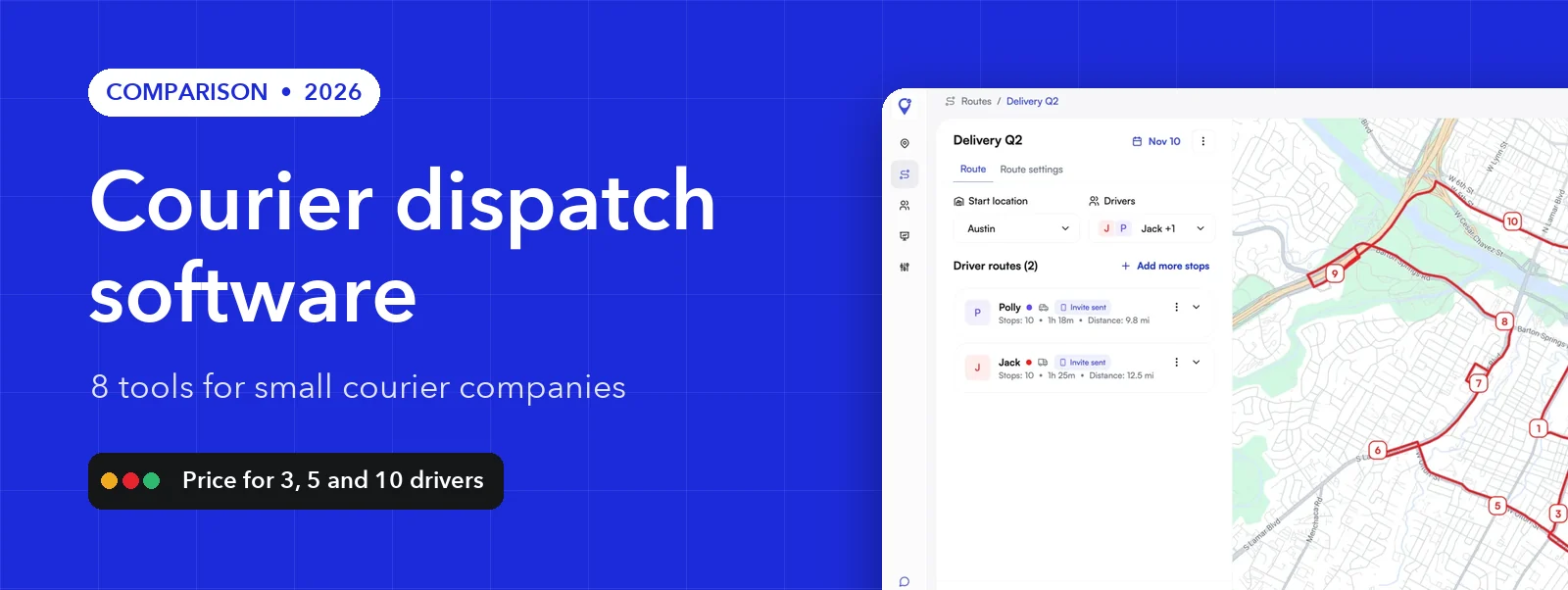
Best Courier Dispatch Software for Small Courier Companies in 2026
Eight courier dispatch tools compared on price for 3, 5 and 10 drivers, free plans, and routes vs on-demand jobs.
Best Apps for Delivery Drivers and Couriers in 2026: Route Planners, Navigation, Mileage and Pay
The best route planner app for delivery drivers, plus navigation, mileage trackers and courier pay, compared for 2026: prices, limits and the catch.
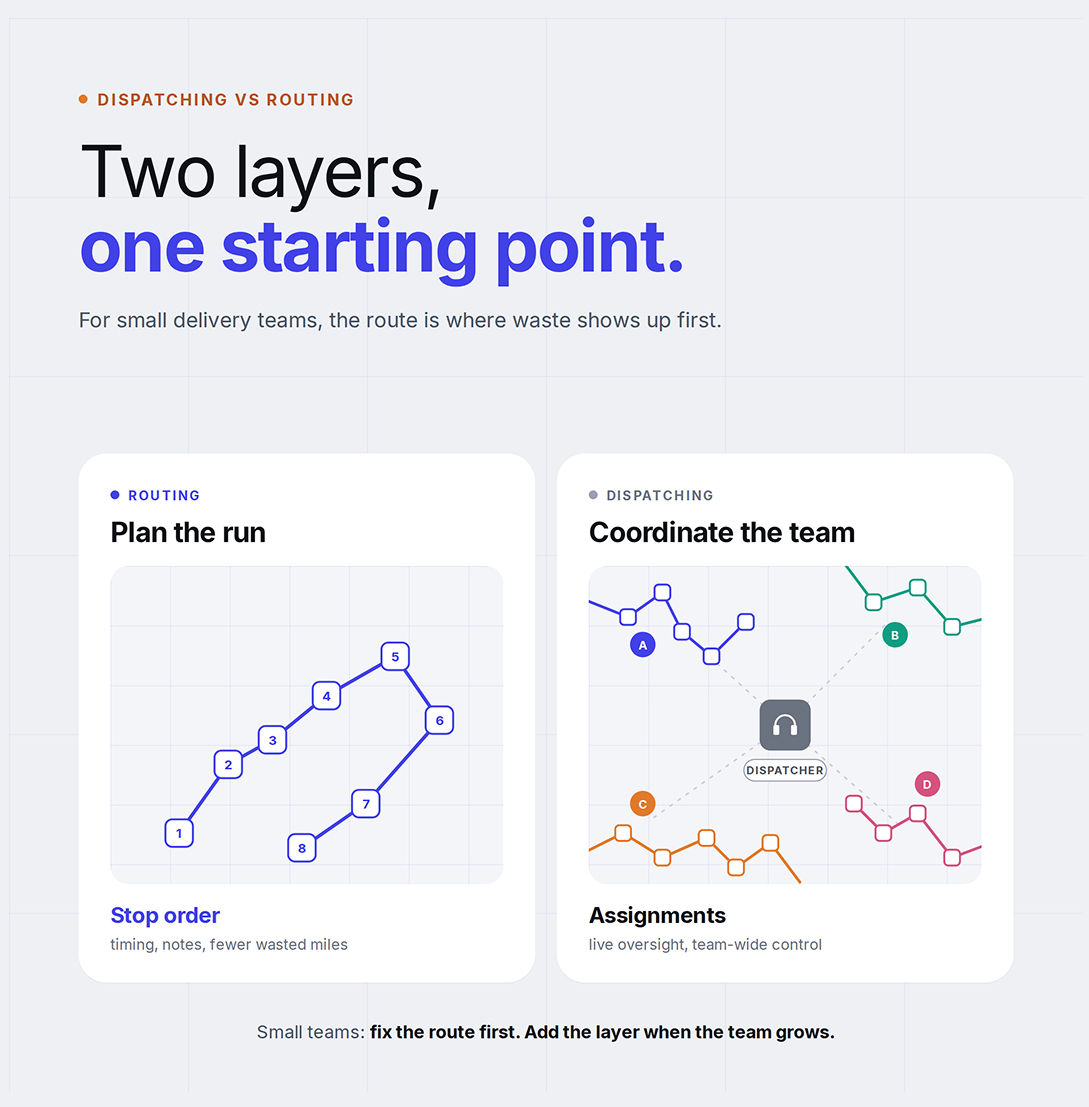
Dispatching vs Routing: Why Small Delivery Businesses Start With Route Optimization
Optiway explains why small delivery businesses usually get more value from better route optimization before adding heavier dispatch workflows.
Plan, assign and track every driver — live, from one dashboard.